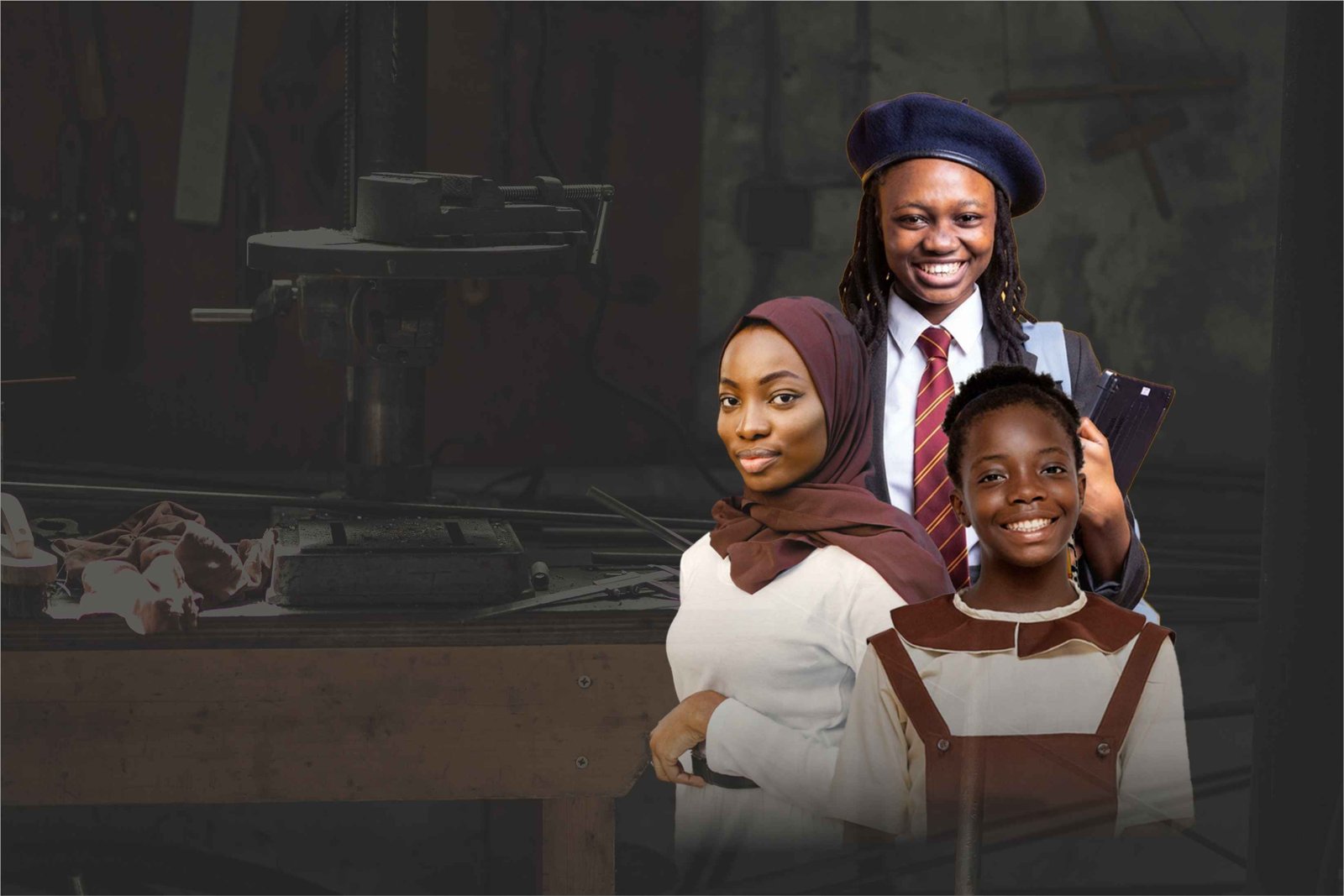
Girls Digital Manufacturing and Product Innovation Challenge.
A nationwide challenge inviting girls in secondary schools across six Nigerian states to design real solutions, build working prototypes in makerspaces, and pitch them at a zonal finale.
Four partners, one pathway.

Hosted by Universal Service Provision Fund (USPF) Nigeria under the Technical Assistance Facility, Implemented by Inovate 2100. Delivered by Digital Manufacturing Makerspace (DMM) and network. Funding comes from UK International Development (FCDO).
Too many good ideas never leave the notebook.
Across Nigeria, girls with sharp ideas for solving real problems rarely get a chance to test them with actual tools.
The Girls' Digital Manufacturing and Product Innovation Challenge is a pilot programme under the Gender and Social Inclusion (GESI) component of the Technical Assistance Facility (TAF), built to grow the participation of girls and young women in Nigeria's innovation, technology, and digital manufacturing ecosystems.
It isn't a business-plan competition. Teams identify a real problem, design a digital solution, and for those who advance build a working prototype inside a partner makerspace, guided by up to two teacher-mentors and technical mentors from first sketch to final demonstration.
- Who can apply
- All-girls teams, secondary schools
- Where
- 6 states, one per geopolitical zone
- Application window
- 11 Sep – 21 Oct 2026
- Ends with
- Six zonal grand finales
Six states, one in every zone.
Each zone is anchored by a technical hub or makerspace. Select a zone to see who leads it.
FCT, Abuja — North Central
Lead hub: Digital Manufacturing Makerspace
Five stages, start to finale.
The funnel gets more hands-on at every stage. Open a stage for what's expected and what it leads to.
Internal Selection
Intra-SchoolEach school forms a team of three to five girls with up to two teacher-mentors, who identify a real problem and an initial solution concept.
Details
Expected: A clear problem, who it affects, and an innovative product idea.
Outcome: One school team with a defined problem and concept.
Virtual Inter-School
Pitching & ScreeningSelected teams pitch their concepts virtually; problem, solution, users, impact and field questions from the panel.
Details
Expected: A clear, evidence-backed pitch and a feasible concept.
Outcome: Three finalist teams per state.
Fabrication Residency
Blueprint to PrototypeFinalists refine their blueprint and business pitch, then join a designated hub in their state.
Details
Expected: A feasible blueprint, business case, and working prototype.
Outcome: A refined blueprint, pitch and functional prototype.
State Grand Finale
Pitch & DemonstrateThe three state finalists present live at the ICT Utilisation Workshop before industry experts, policymakers and stakeholders.
Details
Expected: Communicate the problem, demonstrate the product, defend its value.
Outcome: One State Grand Winner and a validated innovation.
Post-Challenge Support
Beyond the FinalePromising teams are connected to mentorship, incubation, commercialisation and enterprise development opportunities.
Details
Expected: Keep refining the product with mentors, beyond the Challenge.
Outcome: A path towards incubation and enterprise growth.
New to this? Start here.
A short primer on product design and digital manufacturing, before your team starts brainstorming an idea.
Video not loading? Watch it on YouTube instead ↗